
Highlights
- Over 55,000 residents evacuated near Bordeaux due to raging wildfires.
- France has seen over 330,000 evacuations across Europe, with significant damages reported.
- Emergency services involving 2,500 firefighters and military personnel are actively battling the fires.
Wildfires on the Horizon
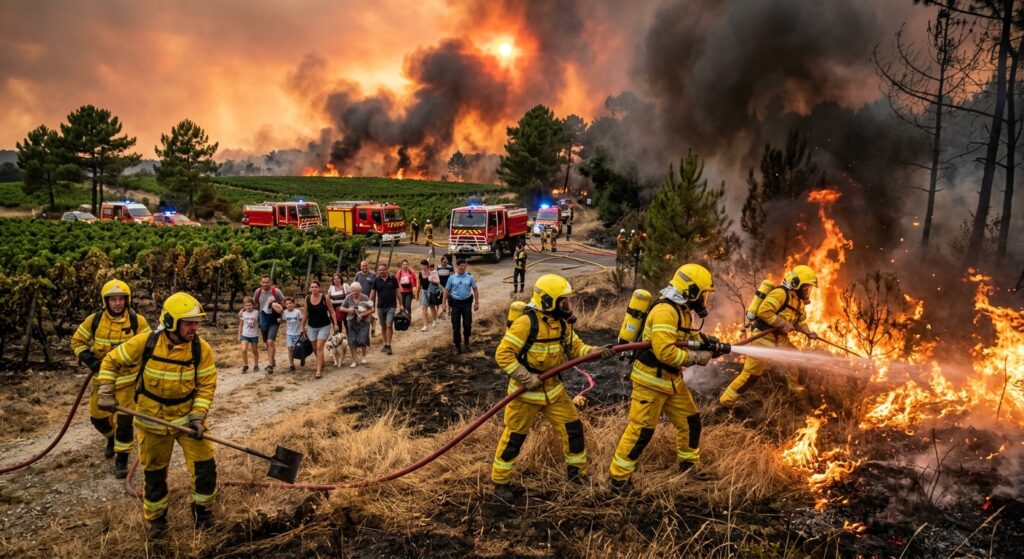
The tranquil region surrounding Bordeaux, renowned for its picturesque vineyards, is currently in a state of emergency as wildfires engulf vast stretches of land nearby. The relentless flames have prompted the evacuation of tens of thousands of residents, with the situation rapidly evolving. By early Sunday, Mayor Thomas Cazenave reassured the community that while the fire is advancing, the immediate risk to the city itself is being properly monitored, and plans for evacuation within the city limits have not yet been deemed necessary.
As drastic wildfires scourge across France and Spain, Bordeaux is now one of the focal points, with over 330,000 evacuations tallied across both countries. France has suffered particularly, witnessing an area of 42,000 hectares devastated in what is being described as one of the country’s largest wildfire incidents since World War Two. This year alone, approximately 98,000 hectares have been burned, posing a challenge that transcends regional borders.
The Battle Against the Blaze
In a collaborative effort to combat these voracious wildfires, around 2,500 firefighters, supported by 1,500 military personnel and nearly 1,200 police officers, have been mobilized in the Gironde region. The firefighting teams are grappling with a furious outbreak that threatens to interact destructively with the local wind systems, complicating their suppression strategies. Captain Nicolas Braz, involved in the firefighting operations, emphasized the challenges posed by the fire’s capacity to generate its own winds, rendering it “erratic and unmanageable.”
Amid these fierce conditions, local authorities have taken precautionary measures, such as closing 60 kilometers of the A63 motorway that connects to Spain. Public events have also felt the impact, notably the final stage of the Tour de France, which has been shortened to allow security forces to redirect their efforts into the firefighting mission. The government is fully engaged, with Interior Minister Laurent Nunez reporting a “very unfavorable” situation with erratic fire movement threatening metropolitan areas.
Looking Forward: Strengthening Resilience
As the flames continue to rage, the broader implications of these disasters drive home the urgent need for improved forest management and disaster preparedness. In response to the devastating losses, President Emmanuel Macron assured the nation of the government’s commitment to recovery, stating that they will be there “for as long as is needed.” The focus now shifts to how communities can adapt to and mitigate these increasingly common survival scenarios.
In light of such disasters, questions loom on how policymakers can balance environmental safeguards and public safety measures while upgrading firefighting resources. Ensuring that the lessons learned from this summer’s devastating wildfires inform future practices is vital for resilience against an uncertain climatic future. What proactive steps can communities take to safeguard their livelihoods? Are current firefighting tactics sufficient for controlling increasingly unpredictable wildfires?
Editorial content by Dakota Sullivan